Last updated: November 2026
Pet insurance for Dalmatians
The Dalmatian is the spotted coach dog of the AKC Non-Sporting Group, a medium-to-large athletic breed recognized by the AKC in 1888. The AKC lists the breed at 19 to 24 inches and 45 to 70 pounds, with the breed standard calling 19 to 23 inches the desirable size and a dog over 24 inches disqualified in the show ring. How long a Dalmatian lives depends on how you count it, and this guide keeps the published methods separate: the AKC lists life expectancy at 11 to 13 years, while the largest UK longevity study measured a median lifespan of 13.2 years. This is a sturdy, long-lived athlete, and its honest planning story is written early: one inherited trait shapes the bladder for life, and a hearing test at a few weeks old tells the other fact that matters, long before a puppy comes home.
Enroll as a puppy, after you have seen the BAER result. In this breed the two facts that shape a lifetime of claims are written into the puppy's genes and hearing test before the first vet visit.
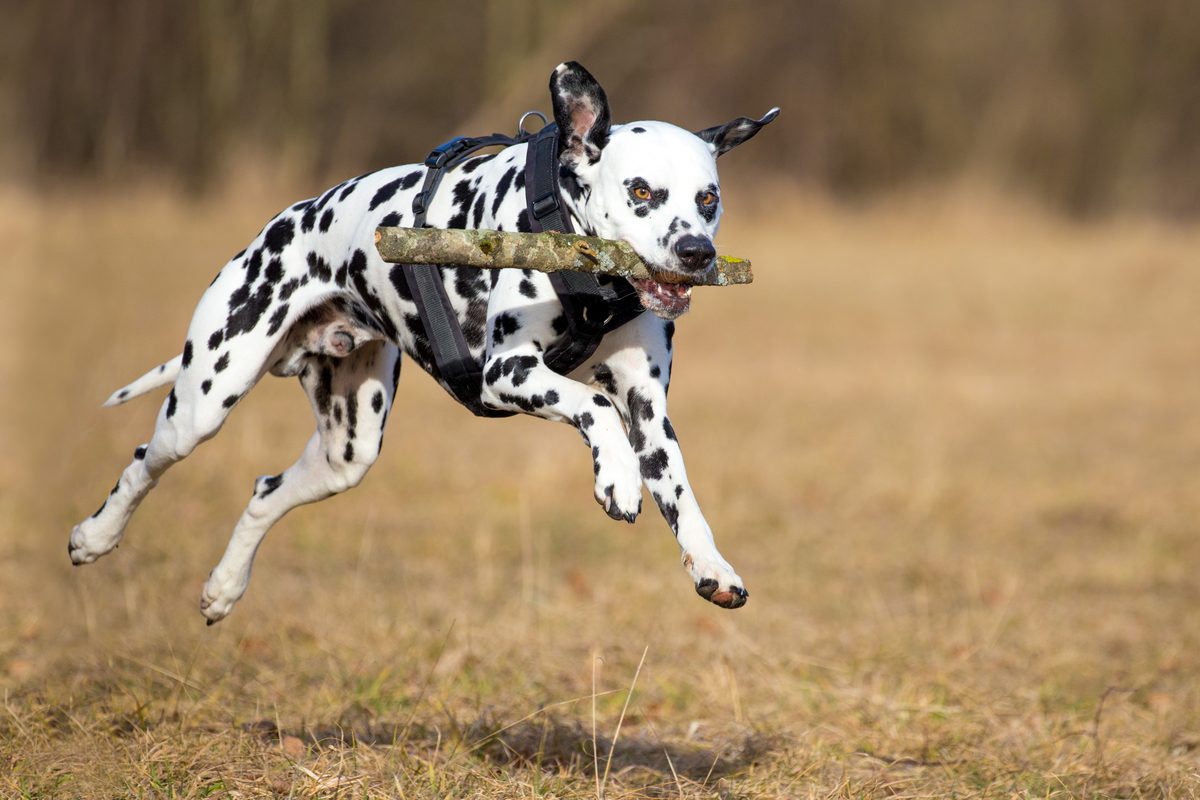
Cost figures are typical ranges, not quotes or guarantees. Your premium depends on your dalmatian's age, your zip code, and the deductible and reimbursement level you choose.
Common health issues in Dalmatians
Urate bladder stones
Risk level: Common / expensive
Bladder stones are the breed-defining risk, and the reason is genetic. In Bannasch et al. 2008 (PLoS Genetics), a missense mutation called C188F in the SLC2A9 gene was shown to cause hyperuricosuria in the dog: the trait is simple autosomal recessive, and every traditional Dalmatian carries two copies of it, because the mutation impairs urate transport in the liver and the kidney, so Dalmatians excrete uric acid where other dogs excrete allantoin. The Merck Veterinary Manual records the clinical side of the same story: Dalmatians excrete poorly soluble urate, and urate stones are highly recurrent, managed with a low-purine diet and monitoring. Most Dalmatians never form a stone, and no stone incidence percent is printed here because none was verified, but a dog that does form one can block, and a blocked male dog is an emergency. Published guides put a planned bladder stone surgery, a cystotomy, at about $1,500 to $3,500, printed here as a guide range. The exception matters as much as the rule: low uric acid Dalmatians, called LUA Dalmatians, descend from a single 1973 Dalmatian and Pointer cross by Dr. Robert Schaible, bred back to purebred Dalmatians for generations, and the AKC accepted their descendants for registration in July 2011. A DNA test through the UC Davis Veterinary Genetics Laboratory and other labs shows which kind a dog is, so a breeder claiming LUA puppies should be able to show the results.
Congenital deafness
Risk level: Common
Hearing is the puppy fact every Dalmatian buyer must know, because it is settled before a puppy comes home. The Dalmatian Club of America's Hearing 101 figures, described there as representative of pre-weaned puppies, put about 70% hearing in both ears, about 22% hearing in one ear only, and about 8% deaf in both ears. The research dataset behind the breed club position, Strain's study of 5,333 Dalmatians, lands in the same place at 70.1% bilaterally hearing, 21.9% unilaterally deaf, and 8.0% bilaterally deaf, and it identifies the Dalmatian as the breed with the highest recorded prevalence of congenital deafness. Those figures describe BAER-tested puppies in breed club and research data, never a share of adult pet Dalmatians. BAER testing, the brainstem auditory evoked response test, is the only reliable answer, it can be done from about 5 to 6 weeks of age, and it is done once for life. A puppy deaf in one ear usually seems completely normal at home, which is exactly why the written BAER result, for the puppy and for both parents, is the first paper a buyer should ask to see. A Dalmatian who hears in one ear, or in neither, can live a full and happy pet life with thoughtful handling and training that uses sight and touch. This page never writes a deaf puppy off.
Skin allergies and atopy
Risk level: Common
Skin is this breed's everyday recurring cost, told here at the strength of its evidence. UK breed health guides name skin allergies and atopic dermatitis among the Dalmatian's common problems, with environmental and dietary triggers, and a veterinary survey of the breed's genetic diseases lists atopic dermatitis among its inherited conditions alongside deafness and hip dysplasia. No skin prevalence percent was verified for this breed, so none is printed. The lived version, for the unlucky share, is years of itch management rather than one dramatic bill: vet visits, medication, and patient detective work on food and environment, repeating across policy years. That repeating shape is exactly what a policy already in place is there to carry, and it is why the first skin note in a dog's record should arrive after enrollment, not before.
Hip dysplasia
Risk level: Less common
Hips are a screening line in this breed, not the headline. The Dalmatian Club of America's CHIC program requires a hip evaluation, by OFA or PennHIP, for breeding dogs, alongside the BAER-based deafness evaluation, which tells its own story: hips in this breed are a result to keep checking, in a sturdy athlete built for distance. Published hip figures for Dalmatians conflict with each other across registries and eras, describing different tested populations, so this page prints no hip percent rather than pick a number it cannot stand behind. What a buyer can stand behind is the paperwork: both parents' hip evaluations, read directly, before a puppy comes home. If a hip does fail in a dog of this size, the bill is a large-dog orthopedic bill, and years of pain management can precede or replace surgery.
What does pet insurance cost for a Dalmatian?
Start from the $62.44/month national dog average (NAPHIA, 2024 data) as an estimate only; there is no trustworthy Dalmatian specific price to quote here. The honest cost shape of this breed is a sturdy, long-lived athlete whose value concentrates in one possible stone emergency, in lifelong urinary management that routine care does not cover, and in years of skin care for the unlucky share, spread across more premium-paying years than most breeds get. Asking to see the puppy's BAER result, both parents' BAER and hip results, and any LUA DNA results, and checking the actual papers, is the single most useful buyer action this page can teach, because a CHIC number means the tests were done, not that the dog passed.
For context, the national average premium for dogs is roughly $62/month - but breed, age, and location move that number a lot. Estimate your premium with our cost calculator, or see the bigger picture in our lifetime cost projector, which compares a common emergency bill with and without coverage.
Breeder testing for this breed has an unusually concrete checklist. The Dalmatian Club of America's CHIC program requires two evaluations, a hip evaluation (OFA or PennHIP) and a congenital deafness evaluation (an OFA evaluation based on a BAER test), plus one elective chosen from an OFA thyroid evaluation or an ACVO eye exam with results registered with OFA. So the papers to ask for are the puppy's own BAER result, both parents' BAER results, both parents' hip evaluations, and, for any LUA claim, the SLC2A9 DNA results. A CHIC number means those tests were done and the results are public, not that the dog passed, so read the actual results on both parents.
Non-Sporting breeds keep each other's company on this site, and each keeps its own figures. Our Bichon Frise insurance guide covers a fellow Non-Sporting breed and a fellow stone-forming breed, whose bladder stone story is told with its own numbers. Our Pug insurance guide covers a small Non-Sporting companion whose breathing and eye care reward the same early start. And our Boston Terrier insurance guide covers another Non-Sporting breed whose breathing story is measured on its own page.
Another Non-Sporting breed joins this one here. Our Chow Chow insurance guide covers the lion-maned ancient breed whose eye and elbow story starts before a puppy comes home, told with its own figures.
What to look for in a policy for a Dalmatian
- Enroll as a puppy, after you have seen the BAER result. In this breed the two facts that shape a lifetime of claims are written into the puppy's genes and hearing test before the first vet visit.
- See the puppy's own BAER result and both parents' BAER results before you commit, and ask for both parents' hip evaluations too. Those papers are this breed's buyer checklist.
- Confirm that urinary conditions and bladder stone surgery are covered, and ask in writing how a breed-wide genetic trait is treated under the hereditary conditions wording.
- Confirm that recurring skin care stays covered across policy years, because allergy care in the unlucky share repeats for years, not weeks.
- If a breeder says a puppy is LUA, ask for the SLC2A9 DNA results by name. A low uric acid claim should come with a test result, not just a promise.
- Keep the deductible at a level you can pay on a hard day without hesitation - the policy only protects your dog if you can afford to use it.
Compare insurers for your dalmatian
Typical plan options from major insurers:
| Insurer | Reimbursement | Annual limit | Waiting periods | Standout feature | Quote |
|---|---|---|---|---|---|
| Spot | 70%, 80% or 90% | $2,500 - unlimited | 14 days (accident & illness) | Preventive-care add-on available. | Get a quote |
| Trupanion | 90% | Unlimited payouts (no annual cap) | 5 days (injury) / 30 days (illness) | Per-condition lifetime deductible; direct vet payment option. | Get a quote |
| Embrace | 70%, 80% or 90% | $5,000 - $30,000 | No wait (accident) / 14 days (illness) / 6 mo (orthopedic, varies by state) | Deductible shrinks $50 each claim-free year. | Get a quote |
| Pets Best | 70%, 80% or 90% | $5,000 or unlimited | 3 days (accident) / 14 days (illness) / 6 mo (cruciate) | Wellness add-on; short accident waiting period. | Get a quote |
| Lemonade | 70%, 80% or 90% | $5,000 - $100,000 | No wait (accident, most states) / 14 days (illness) / 30 days (orthopedic) / 6 mo (cruciate) | Preventive packages; not offered in every state. | Get a quote |
| ASPCA Pet Health Insurance | 70%, 80% or 90% | Multiple annual-limit options | 14 days (accident & illness) | Preventive-care add-on available. | Get a quote |
| Figo | 70%, 80%, 90% or 100% | Up to unlimited annual max | 1 day (accident) / 14 days (illness) / 6 mo (orthopedic) | One of the few with a 100% reimbursement option. | Get a quote |
| Fetch | 70%, 80% or 90% | $5,000 - unlimited | No wait (accident) / 15 days (illness) / 6 mo (orthopedic) | Covers sick-visit exam fees. | Get a quote |
Plan options shown are typical ranges widely published by each insurer; details change and vary by state. Always confirm current terms on the insurer's website before enrolling. Quote buttons link directly to each insurer's website. We don't earn a commission on these links yet.
Other breed guides
- French Bulldog
- Labrador Retriever
- Golden Retriever
- German Shepherd
- Goldendoodle
- Dachshund
- Rottweiler
- Bulldog
- Cavalier King Charles Spaniel
- Shih Tzu
- Boxer
- Australian Shepherd
- German Shorthaired Pointer
- Pembroke Welsh Corgi
- Bernese Mountain Dog
- Border Collie
- Miniature Schnauzer
- Cocker Spaniel
- Yorkshire Terrier
- Great Dane
- Chihuahua
- Pug
- Havanese
- Boston Terrier
- Doberman Pinscher
- Vizsla
- Australian Cattle Dog
- Shetland Sheepdog
- English Springer Spaniel
- Belgian Malinois
- Rhodesian Ridgeback
- Bichon Frise
- Siberian Husky
- Cane Corso
- Chow Chow
- Akita
- Alaskan Malamute
Frequently asked questions
Is pet insurance worth it for a Dalmatian?
For most Dalmatian owners, yes - this is a breed where one major surgery can cost more than years of premiums. The math favors insurance most when the breed's common conditions are expensive, which is the case here.
When should I insure my Dalmatian?
As early as possible - ideally as a puppy. Conditions diagnosed before enrollment are excluded as pre-existing, and this breed's predispositions mean waiting is the expensive mistake.
What is the best pet insurance for Dalmatians?
There is no single best insurer for every dog - the right pick depends on your budget, your dog's age, and which conditions worry you most. Compare annual limits, orthopedic waiting periods, and reimbursement rates across the table above, then run real quotes. (BreedCover may earn a commission if you buy through our links.)